
Snapshot: Kansas Medicaid and Public Health Partnership
Kansas offers a model for bridging Medicaid and public health silos, moving from episodic, event-driven coordination to a...
Tennessee Medicaid Director Stephen Smith talks innovation, fiscal discipline, and what TennCare’s unique shared-savings waiver has made possible—from reinvesting savings back into the people the program serves to rushing relief to communities devastated by Hurricane Helene.
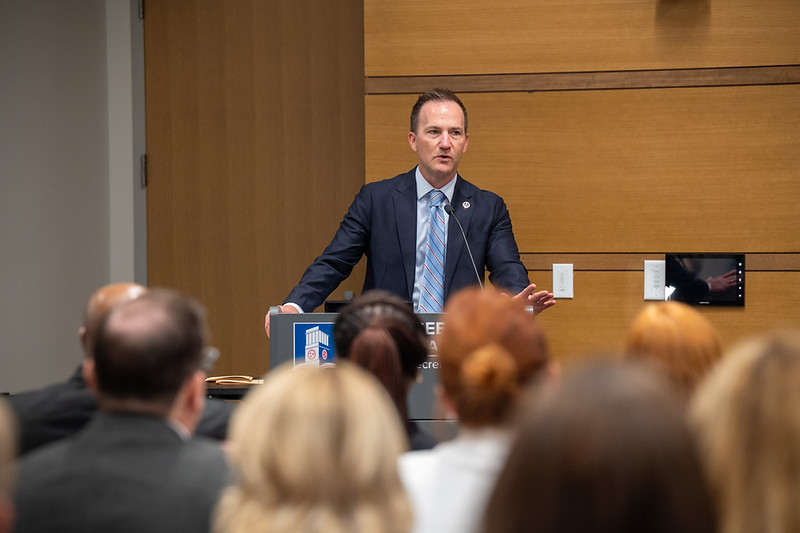
Tennessee Medicaid Director Stephen Smith talks innovation, fiscal discipline, and what TennCare’s unique shared-savings waiver has made possible—from reinvesting savings back into the people the program serves to rushing relief to communities devastated by Hurricane Helene.
Q: What motivated you to pursue a career in public service?

In college, sort of on a whim, I applied for an internship with the Tennessee state legislature and was accepted. I spent a legislative session working for two state senators and had a great experience.
That internship led to a job in the executive branch of state government in an agency, then the nonprofit sector, and then private law practice, but my work was always centered around state government and policy. Ultimately, I ended up back in state government and had the opportunity to serve as Chief of Staff to then-Governor Haslam. When his administration ended, I honestly fell into a role at TennCare and then about a year later was appointed the Director by Governor Lee.
It’s hard to replicate the impact that you can have in public service, and you can do it quickly. Young people on our team will often ask me how they can progress in their careers or move into leadership roles. My advice to them is to find that thing that no one else wants to do – that thing that is too complicated or difficult – and then learn everything you can about that thing. Eventually, the leaders in the organization are going to need to tackle that issue and you will find yourself in the room with those leaders and they will be looking to you as the expert. There are so many complex problems to solve in the public sector, if you’re willing to put in the time and effort, you can do big things and help a lot of people. That’s very hard to find. And ultimately, I guess that is what has kept me here.
Q: TennCare has advanced an incredible array of innovations through its unique shared-savings model. What innovation are you most proud of, and how did that idea go from concept to reality?
I’m very proud of the waiver itself. There were groups and so-called Medicaid experts predicting it would result in massive cuts to the program and calling for our legislature and CMS to reject it. We, of course, were confident in our ability to be successful, and the results have borne that out. In fact, in just the first four years of this 10-year waiver, we’ve achieved $1.3 billion in shared savings that we’ve reinvested in ways that benefit the people we serve. That’s incredible and if I’m honest, the results have exceeded even our highest expectations.
We’ve closed the coverage gap for our parent-caretaker relative population, which is critical for a non-expansion state. We’re serving thousands more individuals with intellectual and developmental disabilities. We’ve committed more than $300 million for rural health initiatives. We became the first state in the country to cover diapers for babies through Medicaid. And so much more.
But if I had to point to one story that really illustrates what this model makes possible, it’s what we were able to do after Hurricane Helene. After being on the ground and seeing the devastation, Governor Lee brought the cabinet together and challenged us to think outside the box for ideas that could help these communities. They needed help with water treatment and debris removal – very costly things. At the end of the day, what is more important and basic to health than clean water and access to care?
So, we worked with our emergency management agency and legislative leadership and transferred $100 million of our shared savings to those communities in record time. That’s rare in government to move that fast with that amount of money. You could see the relief on the faces of those community leaders. It’s just a great example of what government can be, and what government can do when everybody works together. But it would not have been possible without this unique waiver that was designed to think about Medicaid financing differently.
Q: Managing a program that serves 1.4 million Tennesseans requires a strong team. How do you think about hiring and developing the right people for TennCare?
First, I’m looking for character. Humility, kindness, professionalism, respect for others. You can have someone with the highest IQ in the room, but if they can’t work with others, don’t value different perspectives, and think they’re never wrong, I don’t want them on the team. The most effective leaders I’ve worked for and with didn’t tolerate egos, and we don’t tolerate egos at TennCare.
When you look at our leadership team, you’ll see a lot of people who’ve been here a long time and been promoted from within. Our success coincides with remarkable continuity, leaders who’ve experienced both challenges and achievements. That is not a coincidence. But to achieve those successes, you have to create an environment where people feel valued and respected. That comes back to having people with high character.
Beyond character and job-specific skills, I’m always thinking about fit. We have a lot of team discussions where we’re solving problems together, and I want everyone in the room to weigh in, even on issues that aren’t directly in their lane. We talk a lot about how everyone has a role to play in our success, regardless of where you sit on the org chart. Titles don’t make leaders.
Q: TennCare has built a reputation for fiscal sustainability and program innovation. What does it take to sustain that over time?
It takes discipline, consistency, and building partnerships and trust.
In Medicaid, we often debate whether we cover enough people, enough services, or pay enough for those services. But someone has to pay for it, and that someone is the taxpayer, whether through higher taxes or cuts to other things citizens demand.
It really wasn’t that long ago when the TennCare budget was set to consume almost every available new state revenue dollar. The state made some very difficult decisions in the early 2000s and started down the path of fiscal discipline, coupled with innovation. And today we have record investments in public education, public safety, transportation, and so many other areas while also having record investments in Medicaid. That’s not a coincidence. It’s why I often say TennCare is about so much more than just TennCare.
But even here in Tennessee, where I think we’re universally recognized for fiscal responsibility, the rising cost of healthcare is not sustainable. We can never just rest and say we’re done. We have to continually look for ways to bend the cost curve.
One thing I’m really excited about right now is a program our General Assembly just approved: our Pathway to Independence pilot. It’s a first-of-its-kind, four-year pilot designed to incentivize Medicaid members to accept a higher-paying job or a promotion by removing the fear of the Medicaid benefits cliff, that moment when earning more means losing coverage. We know that fear impacts behavior. We also know that if people can get onto private insurance and stay on it for a year, the likelihood of them churning back to Medicaid decreases substantially.
The pilot provides time-limited premium assistance on the private market to our parent-caretaker population, so that if they earn too much to remain Medicaid-eligible, they have another option. We’re looking forward to seeing the results of the pilot but if it works, it will be transformational, helping the people we serve but also resulting in tremendous cost savings.
Q: What advice would you give to partners who want to work more closely with Medicaid?
Be prepared. Data and evidence matter. Understand the landscape and the challenges Medicaid programs are facing, both at the federal and state levels. Don’t ask for things that are unrealistic or unreasonable. And if you are offering something, back it up with real examples and evidence. Everyone says they can save you money – very few can back it up.
Value transparency when it’s given to you. It’s easy to tell people what they want to hear. If someone is telling you the truth about where things stand, they’re respecting you far more than if they’re just saying what gets you out the door.
This is a difficult time in Medicaid, no matter what state you’re in. For people who want to work in this space, understanding the world we work in and the constraints we are under isn’t optional. It’s the starting point.
Drop us your email and we’ll keep you up-to-date on Medicaid issues.