
NAMD Comments on Amending the Indirect Hold Harmless Threshold of Health Care-Related Taxes
On September 21, NAMD submitted comments on CMS' NPRM on Amending the Indirect Hold Harmless Threshold of Health...
This resource provides a high-level summary of NAMD’s comments on CMS’ 2026 proposed rule on Medicaid managed care state directed payments and targeted Medicaid fee-for-service payments.
This resource provides a high-level summary of NAMD’s comments on CMS’ proposed rule on Medicaid managed care state directed payments and targeted Medicaid fee-for-service payments. For a more detailed analysis, read NAMD’s full comments here.
In Medicaid managed care delivery systems, states and territories pay health plans a fixed amount per member, known as a capitation payment, to administer covered benefits. Health plans generally decide how much to pay providers, but federal rules let Medicaid agencies direct certain provider payments through state directed payments (SDPs). States and territories use SDPs to require managed care plans to pay specified rates to certain providers. These arrangements are intended to strengthen provider networks, maintain access to care, support quality improvement and value-based payment initiatives, address workforce and reimbursement challenges, and advance broader delivery system transformation.
Section 71116 of H.R. 1 – the One Big Beautiful Bill Act (OBBBA) established new payment limits for certain SDPs. Payment rates generally may not exceed 100 percent of the applicable Medicare payment rate in states that have adopted the Affordable Care Act’s Medicaid expansion or 110 percent in states that have not. When there is no comparable Medicare rate, the limit is the payment rate established under the state’s Medicaid state plan.
The legislation temporarily grandfathers certain existing SDPs: arrangements already approved or in development can remain above the new limits while transitioning to the new framework. Beginning with the first managed care rating period on or after January 1, 2028, states must reduce each grandfathered SDP by 10 percentage points of its original grandfathered amount each year until the arrangement reaches the applicable payment limit.
In practice, this lowers the maximum payment rates states can direct through Medicaid managed care organizations (MCOs). States with SDPs above the new limits will need to reduce payments or redesign their arrangements, which could affect provider reimbursement and states’ ability to support quality improvement and value-based payment initiatives.
The proposed rule would implement these statutory requirements and establish additional policies governing SDPs and targeted FFS payments. CMS proposes to:
Medicaid programs share CMS’ commitment to responsible stewardship of taxpayer resources, strong program integrity, access to care, and quality. At the same time, states and territories rely on SDPs to meet local access and workforce needs and support broader delivery system goals. NAMD’s comments encourage CMS to preserve state and territory flexibility, avoid unnecessary administrative burden, and provide sufficient transition time and clear pathways for existing arrangements. NAMD encourages CMS to work directly with Medicaid agencies to develop the methodologies, guidance, and technical assistance needed to implement the new requirements.
Recommendation: CMS should limit the new payment caps to the service categories identified in OBBBA. If CMS applies the limits more broadly, it should extend grandfathering to all affected service categories and provide clear, flexible approaches for services without a meaningful Medicare equivalent. CMS should also let states define reasonable geographic areas beyond counties and traditional rural designations to address localized access needs through targeted FFS payments.
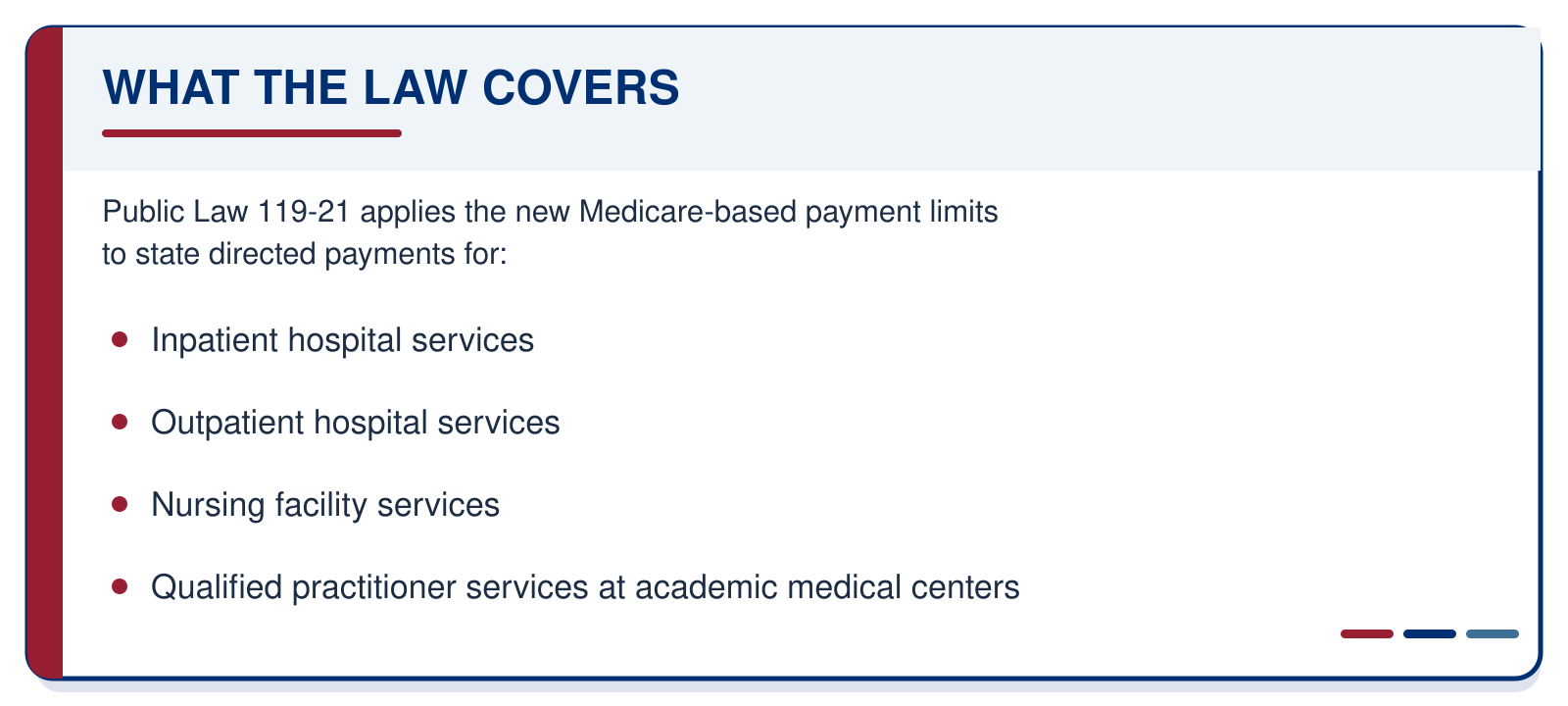
A broader policy could have significant implications for services that have consistently received targeted investments because of historical underfunding, including primary care, behavioral health, and home and community-based services. Some states and territories have intentionally adopted reimbursement approaches that exceed Medicare rates to address workforce shortages, improve access, or support rural and frontier communities. Applying Medicare-based limits in these circumstances could constrain agencies’ ability to respond to local program needs.
Medicare also is not always meaningful benchmark for Medicaid services. The proposed rule does not clearly explain how the limits would apply to state plan-approved bundled payments, managed-care-only services without a state plan equivalent, or services furnished by Federally Qualified Health Centers, where Medicaid and Medicare payment methodologies differ significantly. Similar questions arise for targeted FFS payments. CMS’ proposal recognizes that geographically targeted payments can help address local access challenges, but its focus on counties and rural designations may not reflect how services are organized in every state. Ambulance service regions, public health regions, and other operationally defined areas may more accurately reflect how care is delivered and accessed.
Recommendation: CMS should partner with Medicaid agencies to surface and address operational challenges with provider- and service-level data reporting and Medicare payment comparisons, and jointly develop workable reporting methodologies, templates, and guidance. In the interim, states should be allowed to use alternatives such as aggregate analyses, actuarial certifications, or other approaches that provide meaningful oversight. CMS should also allow states to rely on rates that are effective under approved state plan methodologies, even when formal approval occurs after the rating period begins.
CMS proposes applying the payment limits retrospectively at the individual provider and service or discharge level. That would require states and territories, managed care plans, providers, and actuaries to build and maintain detailed crosswalks between Medicaid and Medicare reimbursement methodologies. Medicaid agencies would also need to identify every SDP-eligible provider, report the applicable Medicare or state plan rate, and describe the systems and controls used to keep each payment within the limit.
This raises practical challenges. Medicaid and Medicare do not always cover or pay for services comparably, and differences in populations, utilization, benefits, and reimbursement methodology can make one-to-one comparisons difficult. Some states use Medicare diagnosis-related groups but develop their own weights to reflect Medicaid utilization. Medicare weights for neonatal, obstetric, and pediatric services may not reflect the cost of care because these services have a limited footprint in Medicare. Other Medicaid services may rely on per diem, bundled, or other methodologies that do not align directly with Medicare payment structures.
Provider-level reporting would also demand significant operational planning, data validation, and ongoing monitoring. Provider participation and National Provider Identifiers can change during a plan year, and Medicaid agencies may not have ready access to information on which providers furnish particular services through each managed care plan. Meeting these requirements could require new investments in information technology, vendor support, data analytics, and compliance monitoring.
The methodology could also affect quality improvement and value-based payment arrangements. Providers that have already reached the payment limit could become ineligible for additional performance incentives, limiting states’ ability to reward high-quality care. Differences in provider participation across managed care plans could further complicate performance calculations, capitation rate development, and SDP administration.
CMS’ proposed treatment of the state plan-approved rate raises a separate timing concern. State plan rates can take effect months before CMS formally approves the state plan amendment. If states cannot use those rates in managed care until approval is complete, FFS and managed care reimbursement could fall out of alignment, and updated rates may not be incorporated into annual capitation rate development.
Recommendation: CMS should provide flexibility in determining grandfathered SDP amounts and consider alternatives to relying solely on Item 4. States should be permitted to provide other evidence of actual or expected SDP spending. CMS should also clarify how the grandfathering and graduation tests will be calculated and applied, and continue permitting separate payment terms during the transition.
NAMD supports CMS’ effort to provide a transition period for grandfathered SDPs. A key issue for states and territories, however, is how CMS would determine the total dollar amount protected during that period. The proposed rule would use the estimated total dollar amount reported in Item 4 of the SDP preprint, the standardized form states submit to CMS when seeking approval for an SDP, as the sole basis for determining the grandfathered amount. States and territories did not understand this estimate to function as a binding spending limit.
States may also have completed Item 4 differently: some reported only the incremental increase associated with the directed payment, while others reported the total value of payments for the affected services. As a result, similarly situated arrangements could receive different grandfathered amounts based on how states interpreted the preprint instructions. Item 4 may also be an estimate that does not reflect actual spending, which can change with enrollment, utilization, provider participation, and other factors outside the state’s control.
Additional clarity is needed on how an SDP moves through the transition. The proposed rule references the Medicare payment limit both to determine whether an arrangement remains grandfathered and whether it has “graduated” from grandfathered status. It is unclear whether these are distinct tests, how they would be calculated, or whether they would be applied at the provider, service, or another level.
NAMD supports CMS’ proposal to temporarily continue allowing separate payment terms, under which funding for an SDP may be paid to managed care plans separately from their regular capitation payments, during the grandfathering period. This flexibility would give states, managed care plans, and providers time to transition existing arrangements while reducing operational disruption and fiscal risk. NAMD also supports applying the annual 10-percentage-point phase-down to the original grandfathered amount rather than the prior year’s reduced amount, for more predictable budget planning.
Recommendation: CMS should continue allowing uniform rate increase SDPs within the applicable payment limits. The new payment limits already provide a guardrail on reimbursement levels, making an additional prohibition unnecessary and potentially disruptive to existing financing and delivery system strategies.
A uniform rate increase SDP requires managed care plans to increase payment rates by the same amount or percentage for all qualifying providers within a defined provider class. CMS proposes prohibiting uniform rate increase SDPs and renewals of non-grandfathered uniform increase SDPs beginning with rating periods on or after January 1, 2028. Once a grandfathered SDP meets the applicable payment limit, the state or territory would also need to redesign the arrangement, because it could no longer operate as a uniform increase.
Uniform rate increases provide states and territories a straightforward way to support access, quality, provider stability, and delivery system goals. Additionally, since CMS’ proposed Medicare-based payment limits already place a ceiling on reimbursement, a separate prohibition on uniform increases would further restrict state payment design without providing a clear additional safeguard.
NAMD appreciates CMS’ focus on fiscal accountability and sustainable Medicaid financing. As CMS finalizes the rule, the agency should preserve state and territory flexibility, account for differences between Medicaid and Medicare payment systems, and provide workable implementation and transition pathways. NAMD encourages CMS to continue working with Medicaid agencies to refine the proposed methodologies and provide the guidance and technical assistance states and territories need to implement these changes.
Drop us your email and we’ll keep you up-to-date on Medicaid issues.