
Snapshot: Kansas Medicaid and Public Health Partnership
Kansas offers a model for bridging Medicaid and public health silos, moving from episodic, event-driven coordination to a...
Medicaid and the Ryan White HIV/AIDS Program are two public programs that help ensure low-income people with HIV have access to the full continuum of care to manage their chronic disease. Although each program has distinct eligibility and coverage criteria, Medicaid and the Ryan White HIV/AIDS Program often work together to provide comprehensive care for people with HIV.
In 2024, the Centers for Disease Control and Prevention (CDC) estimated that more than 1.1 million people in the U.S. aged 13 and older were living with diagnosed HIV. Timely testing, diagnosis, and treatment are essential to improve health outcomes among people with HIV and to prevent transmission to others. Medicaid and the Ryan White HIV/AIDS Program are two public programs that help ensure low-income people with HIV have access to the full continuum of care to manage their chronic disease. Medicaid is the largest source of federal funding for HIV care in the U.S., followed by Medicare, and the Ryan White HIV/AIDS Program, which is administered by the Health Resources and Services Administration (HRSA). Although each program has distinct eligibility and coverage criteria, Medicaid and the Ryan White HIV/AIDS Program often work together to provide comprehensive care for people with HIV.
Medicaid provides healthcare coverage for eligible low-income individuals, families, and children. The program is jointly financed and administered by the federal government, states, and territories. The federal agency that oversees the Medicaid program is the Centers for Medicare & Medicaid Services (CMS), an agency within the U.S. Department of Health and Human Services (HHS).
The federal government establishes baseline requirements for Medicaid eligibility, covered services, and processes, which states and territories can build on to tailor their programs to local needs and priorities. Because of this flexibility, Medicaid programs vary across each state and territory in terms of who is eligible and what benefits are covered.
However, all states and territories cover the same mandatory eligibility groups, including:
States and territories may choose to cover additional eligibility groups, such as adults without children or certain disabilities (often referred to as the “Medicaid expansion population”).
Like eligibility groups, all states and territories are required to cover the same set of mandatory benefits. These mandatory benefits include, but are not limited to:
States and territories may choose to cover an array of optional benefits, such as dental services and eyeglasses. Prescription drug coverage is also an optional benefit, but all states have elected to cover that optional benefit.
As of 2018, Medicaid covered approximately 40% of nonelderly adults with HIV, making Medicaid the largest source of healthcare coverage for people with HIV in the U.S. Low-income people with HIV may qualify for Medicaid through the disability pathway, another mandatory eligibility pathway (e.g., as a low-income parent or foster youth), or an optional eligibility pathway their state has adopted, such as the Affordable Care Act’s Medicaid expansion to low-income adults.
Medicaid covers an array of healthcare services and treatments for HIV diagnosis, treatment, and prevention. For example, Medicaid must cover “medically necessary” HIV testing and may cover routine HIV testing depending on the state. For people with HIV, Medicaid’s prescription drug benefits cover certain antiretroviral treatments, with variation among states on the specific antiretroviral treatments that are covered. Antiretroviral treatments can help someone reach and maintain viral suppression, which means that someone’s viral load becomes undetectable, and they cannot sexually transmit the virus. Viral suppression also dramatically reduces the risk of transmission during pregnancy, labor, delivery, and breastfeeding. Access to antiretroviral medication treatment is therefore a key tool in preventing HIV transmission. Additionally, Medicaid is required to cover PrEP (or pre-exposure prophylaxis) without cost sharing, which is the use of antiretroviral medication to prevent HIV among people who are at an increased risk.
In addition to covering HIV prevention and treatment services, Medicaid also covers services for other common co-occurring conditions among people with HIV. For example, Medicaid provides coverage for mental health and substance use disorder services. Addressing co-occurring conditions has been shown to improve the overall health of people with HIV and help support adherence to antiretroviral treatment.
The Ryan White HIV/AIDS Program (RWHAP) helps low-income people with HIV access medical care, medications, and other support services that help people stay in care. Congress enacted the program in 1990 by passing the Ryan White Comprehensive AIDS Resource Emergency (CARE) Act. Today, the Ryan White HIV/AIDS Program provides services to more than 600,000 people with HIV, which represents over half of all people with HIV in the U.S.
People can receive services through the Ryan White HIV/AIDS Program if they meet all the following criteria:
The program provides grants to states and territories, cities, counties, clinics, community-based organizations, and other entities to deliver healthcare services, medications, and other support services related to HIV.
The Ryan White HIV/AIDS Program has five distinct parts (Parts A – F) that are focused on providing different services through state or local grant recipients.
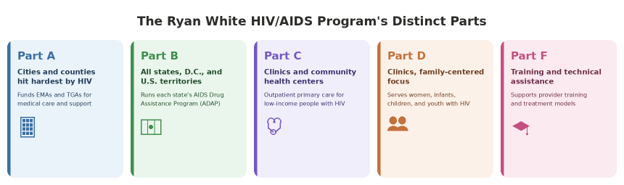
There are statutory requirements for how grant recipients use Ryan White HIV/AIDS Program funding to deliver care, provide medications, and other services. Grant recipients have flexibility within those requirements to tailor aspects of their programs to meet the needs of people with HIV residing within the state or territory. For example, Ryan White HIV/AIDS Program Parts A – D grant recipients must spend at least 75% of funds on core medical services, but states and territories can decide which services to provide from the list of core medical services defined by HRSA. These core medical services include but are not limited to:
Ryan White HIV/AIDS Program funding also helps provide additional support services that help people remain connected to routine care, including but not limited to:
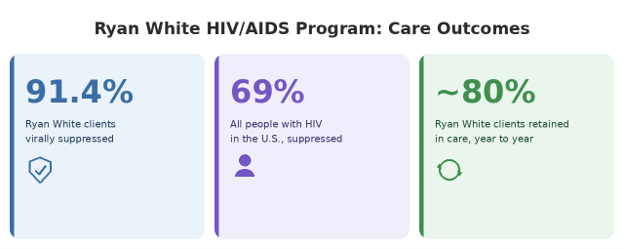
Research shows that clients of the Ryan White HIV/AIDS Program are more likely to see improved health outcomes compared to people not receiving program support. In 2024, 91.4% of patients receiving HIV medical care through the Ryan White HIV/AIDS Program were virally suppressed, compared with 69% of all people with HIV in the U.S. Additionally, clients of the Ryan White HIV/AIDS Program have stable care retention rates with nearly 80% of clients remaining in care from year to year.
Many people served by the Ryan White HIV/AIDS Program are also enrolled in Medicaid. As of 2024, nearly 30% of Ryan White HIV/AIDS Program clients were covered by Medicaid and 7% were dually covered by Medicaid and Medicare. When a person is enrolled in both Medicaid and receives services through the Ryan White HIV/AIDS Program, the Ryan White HIV/AIDS Program serves as the payor of last resort and can provide coverage for care and services not covered by Medicaid. This may include coverage of additional case management visits when the state or territory has a cap on the number of visits covered by Medicaid, and the person with HIV has ongoing case management needs. The Ryan White HIV/AIDS Program also helps to provide access to care, medications, and other services for low-income people with HIV who do not qualify for Medicaid.
People may also transition onto and out of Medicaid coverage due to changes in life circumstances, such as starting a new job. When those changes in circumstances occur, a person may transition to another healthcare coverage option that does not cover the same array of HIV-related care. In those cases, the person may rely more on services through the Ryan White HIV/AIDS Program. Coordination between Medicaid and the Ryan White HIV/AIDS Program on covered medications and healthcare services can help make sure there are no gaps in routine care and adherence to treatment during periods of transition. For example, a state may design the drug formulary for their ADAP program so that it aligns with their Medicaid preferred drug list.
Additionally, data sharing between Medicaid and the Ryan White HIV/AIDS Program can help support continued access to healthcare services and improve care coordination for people with HIV. This data sharing between programs may also help states and territories with annual reporting requirements to measure the quality of care delivered to Medicaid members, known as the Core Sets of Health Care Quality measures. In the Core Sets measures, HIV viral load suppression for adults enrolled in Medicaid is a voluntary measure that states and territories can report as of 2026.
Medicaid and the Ryan White HIV/AIDS Program are two public programs that help low-income people with HIV access the care they need to manage their chronic disease, from early diagnosis to treatment services that help people reach and maintain viral suppression. Understanding the unique role that each program plays – and how they work together – is important for state and local leaders who are seeking to improve health outcomes of people with HIV, reduce the spread of HIV, and promote public health.
Drop us your email and we’ll keep you up-to-date on Medicaid issues.