
NAMD Comments on Community Engagement Requirement for Certain Individuals Interim Final Rule With Comment
On July 31, 2026, NAMD formally commented on the CMS Community Engagement Requirement for Certain Individuals Interim Final...
An explainer on how ex parte automates eligibility and how federal law envisions ex parte processes will support community engagement implementation
Under federal requirements (42 CFR 435.916), Medicaid agencies must attempt to determine a member’s eligibility without requiring action from the individual – a process known as ex parte. The requirement has been a part of Medicaid eligibility policy for over a decade, though it has expanded in recent years, including in H.R. 1: The One Big Beautiful Bill Act (OBBBA). Policymakers have pointed to potential operational benefits of ex parte, including reducing administrative work for Medicaid agencies and Medicaid members, and increasing the accuracy of Medicaid eligibility determinations.
The current framework was established in 2012 under a federal rule implementing the Affordable Care Act (ACA) for eligibility changes that required states to use available and trusted data before asking members for information at renewal. The ACA also drove the creation of the Federal Data Services Hub, which launched in October 2013 and gave states a single connection point to federal data sources – like IRS income and Social Security Records – that had previously required separate data and security agreements to access.
States comply with these federal requirements by:
In the years that followed passage of the ACA, states focused on building new eligibility systems and gradually ramped up implementation of the ex parte requirement. As of January 2020, there was wide variation in states’ ex parte rates.
Ex parte took on increased prominence during the unwinding of the COVID-19 Public Health Emergency (PHE) continuous coverage requirement. Starting in April 2023, states had to redetermine eligibility for all enrollees for the first time in over three years. At the start of unwinding, the national ex parte rate was approximately 30 percent. Through investment in data connections and system automation, the national average rose to over 55 percent by the end of the unwinding period. These efforts have helped modernize application and renewal processes by moving away from more manual processes.
Congress elected to build on the use of ex parte processes in H.R. 1, the One Big Beautiful Bill Act (OBBBA). The law requires states to use ex parte for verifying compliance with, or exclusions from, work and community engagement requirements before requiring an individual to provide information. OBBBA also increases the frequency of renewals for the expansion population from once every 12 months to once every 6 months, meaning states will run ex parte twice as often for this group. This means that as states implement work and community engagement requirements, they are focused on expanding and modernizing data sources for ex parte verification.
While implementing the ex parte process can be complicated, the outlined steps as identified in the November 2024 CMCS Information Bulletin provide guidance to Medicaid agencies:
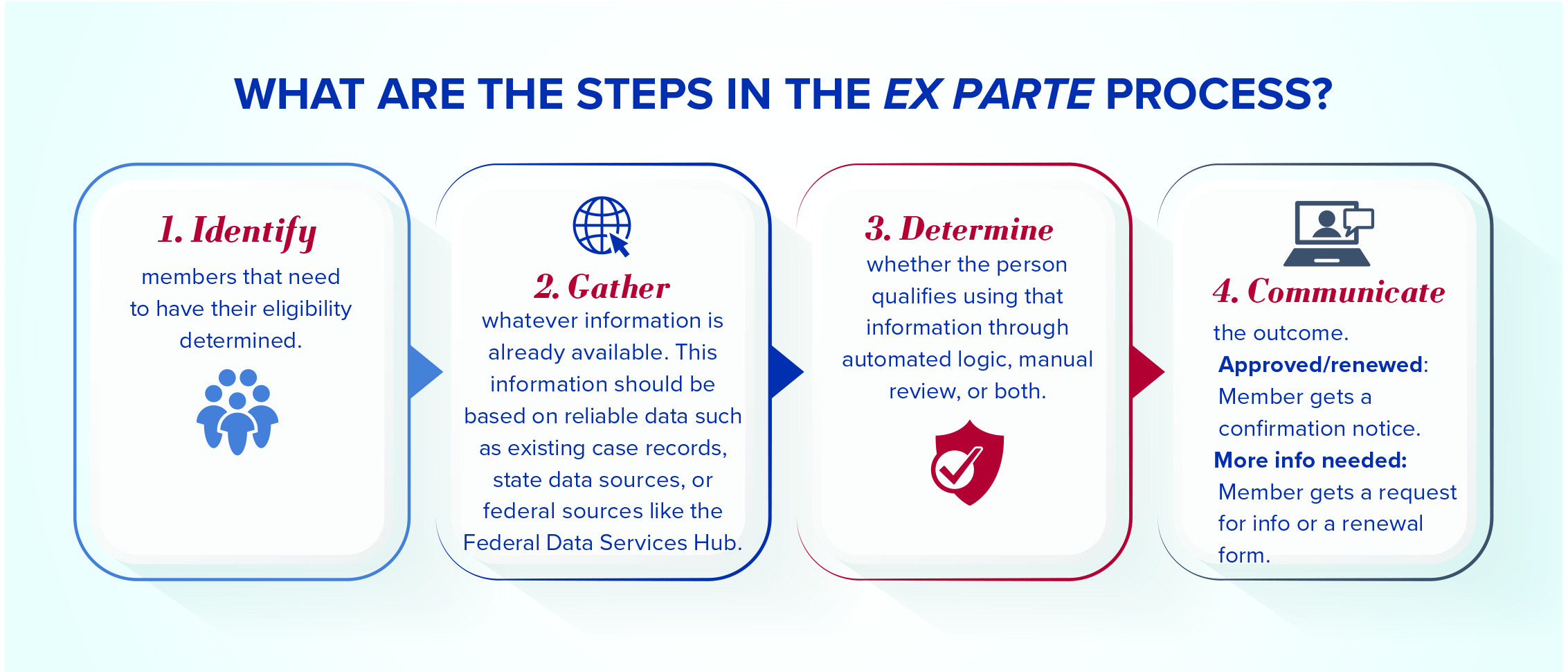
The common idea is that states use information that the state already has to simplify steps for Medicaid members and state staff. If a state can’t determine if a member is eligible, it asks for more information from the member and incorporates that information into the case file. State staff can then determine based on that additional information if someone is eligible for continued coverage.
Ex parte renewal processes are dependent on the data available to the state. States draw on a combination of state, federal, and commercial data sources when attempting to verify a member’s eligibility without requiring information from the individual.
The Federal Data Services Hub is the primary federal infrastructure supporting this process. Built as a part of the ACA implementation and operational since October 2013, to coincide with the launch of the marketplaces, the Hub provides Medicaid agencies with a single connection point to multiple federal data sources that had previously required separate connections and data sharing agreements.
While data sources are continually being added, Medicaid agencies have historically been able to use the Hub to leverage reliable data from organizations such as: Social Security Administration for Social Security Number Verification, Department of Homeland Security for Citizenship verification, and CMS for Medicare enrollment and other coverage. The Hub also connects to commercial sources like the Verify Current Income function, which can provide employment and income verification based on payroll records contributed by employers. Medicaid agencies must pay to leverage these commercial data sources. As state use of the Hub grew, CMS reported a sevenfold increase and transitioned the function to a Medicaid-claimable service at the 75/25 match beginning July 1, 2024.
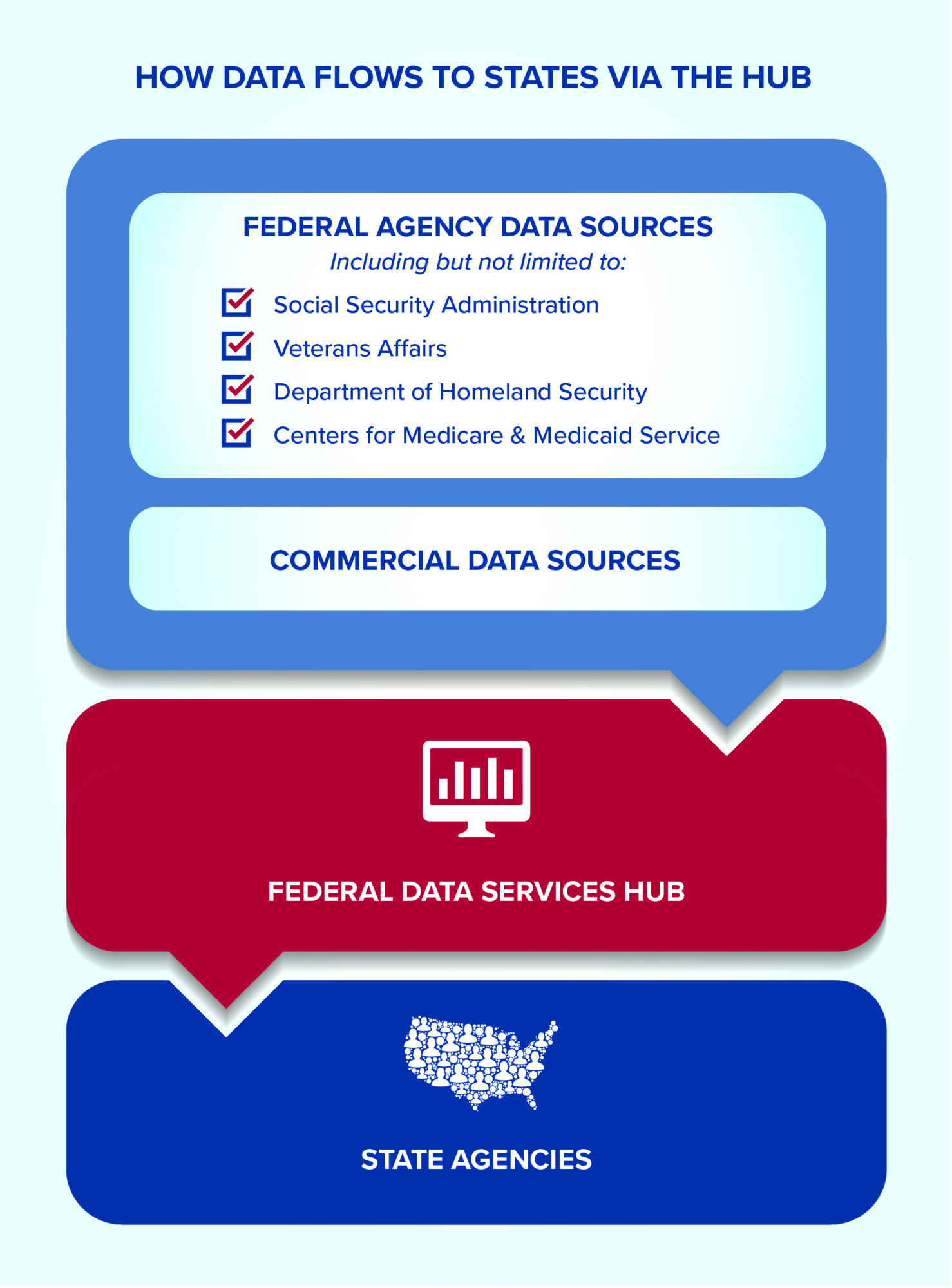
While the Hub covers many verification needs, its existing data sources are not sufficient to verify compliance with – or exemptions from – the new work and community engagement requirements. In 2026, CMS launched new open-source solutions including Eligibility Made Easy (Emmy), an open-source tool designed to fill these gaps. Emmy supports consent-based income verification, and the ability for members to upload documents supporting volunteer activity. In the June 2026 Interim Final Rule implementing the work and community engagement requirements, CMS also indicated that they are exploring pulling additional data sources, like National Student Clearinghouse and U.S. Department of Veterans Affairs data, into the Hub.
States supplement the Hub and Emmy with their own data sources. State wage and earnings records are among the most used data connections for verifying income at renewal. Some States have also enhanced the accuracy of their ex parte renewals by drawing on SNAP and TANF program data, Department of Corrections records, vital statistics, asset verification systems for non-MAGI populations, and in some cases newer sources like U.S. Postal Service change of address or state lottery and gaming records to flag changes in circumstances.
Consider a working parent enrolled in Medicaid whose renewal is approaching. The state system flags the case 60 to 90 days before the eligibility period ends and begins the ex parte process by pulling information already in the member’s case, then querying available data sources such as state wage records, the Federal Data Services Hub, and commercial data sources.
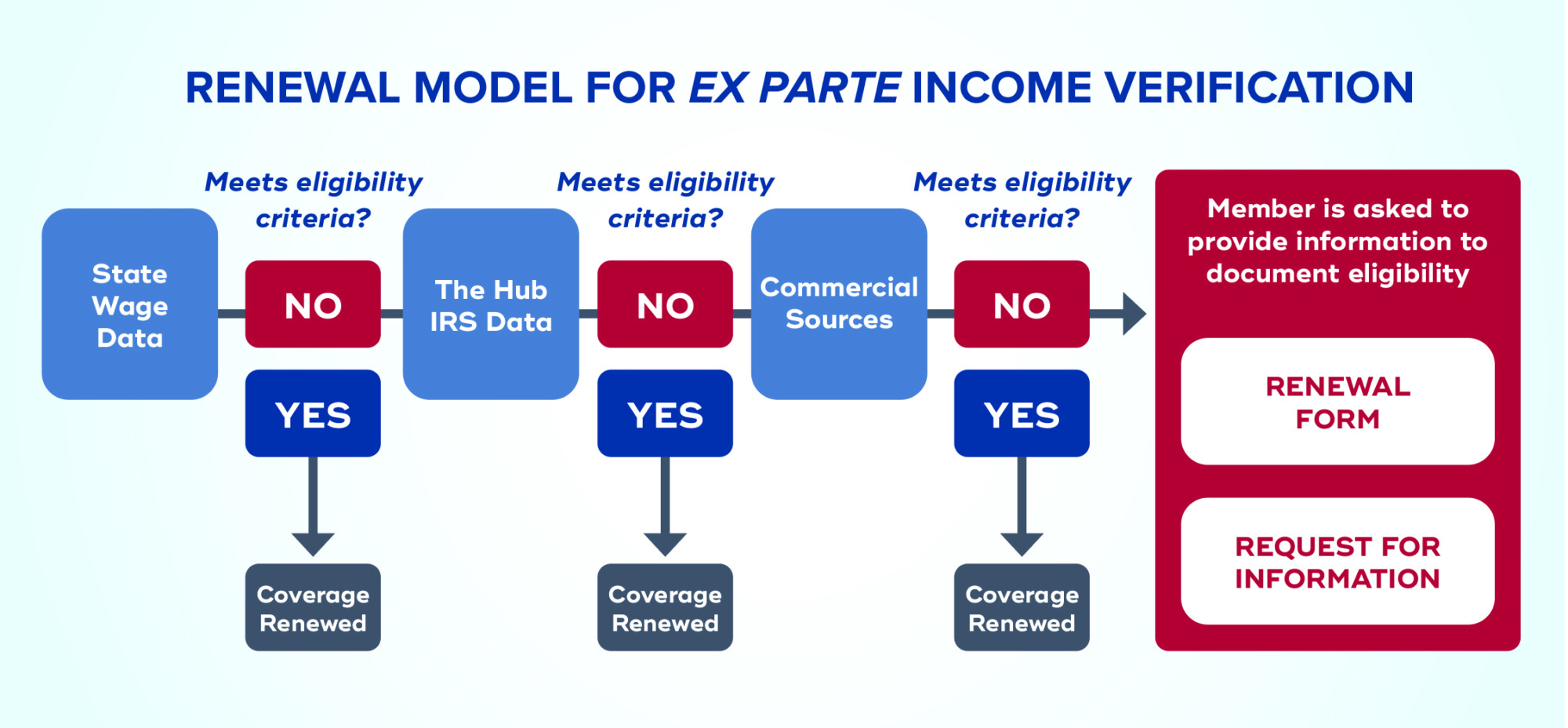
If the Medicaid agency cannot complete the renewal via ex parte, either because adequate data is not returned or because the returned data indicates that the individual may not be eligible for Medicaid, the Medicaid agency must send the individual a renewal form that the individual must complete.
Over the past several years, state and federal policymakers have expanded the use of automated ex parte. This has been driven by federal law, an increased focus on system modernization, and a desire to simplify eligibility processes for state caseworkers and individuals served by the program.
Policymakers have pointed to three potential operational benefits of ex parte renewals:
Because automated ex parte renewals occur without caseworker intervention, they are dependent on strong data infrastructure. This includes timely access to complete and current data, along with accurate systems instructions that review data sources in accordance with the state or territory verification of business rules. Medicaid agencies must also have strategies for auditing their ex parte processes, to ensure that their systems are adjudicating cases in line with state/territory and federal eligibility policy. The relationship between automated ex parte processes and the accuracy of eligibility determinations is an area where more research is needed.
Over the coming years, ex parte processes will continue to be a focus area for Medicaid agencies. OBBBA introduces changes to Medicaid eligibility policy, including work and community engagement requirements for low-income adults who do not have dependent children or certain disabilities (i.e., the expansion group), along with more frequent redeterminations for this same enrollment group. States are focused on ex parte processes as they implement these policy changes.
In OBBBA, Congress explicitly requires states to use available data sources to attempt to verify if an individual meets the work and community engagement requirements – or falls under an exemption or exclusion – before requesting information from the individual.
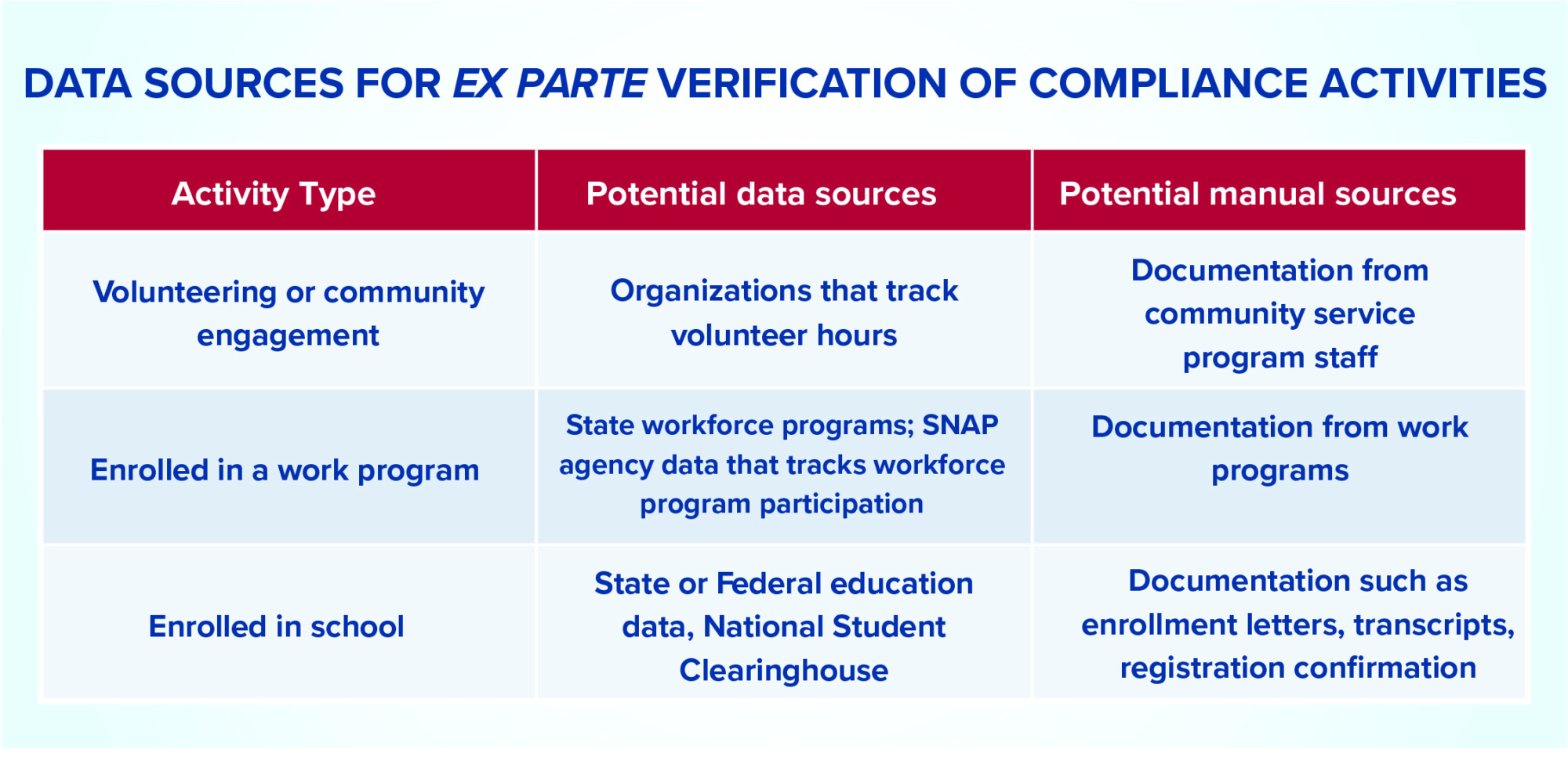
States will be able to use existing ex parte data sources to verify some forms of compliance and some exclusions. For example,
The data structure to support ex parte verification for some activities (such as volunteering or enrollment in an educational program) and some exclusions (such as veterans with 100% rated disability) may not yet exist in some states. States are focused on identifying and linking to these data sources as they implement work and community engagement requirements. CMS has also developed new tools, such as the open-source Emmy tool, to support connections to verifiable data sources.
These changes arrive alongside an increase in renewal frequency: starting January 2027, renewals for the expansion population will move from once every 12 months to once every 6 months. CMS confirmed in a March 6, 2026 State Medicaid Director letter that states must still attempt ex parte verification before contacting a member at every renewal. This means that states will run ex parte twice as often for this population. Medicaid agencies are focused on operational improvements like robust data connections, accurate system logic, and regular reporting on ex parte processes to manage this increased volume of renewals.
Ex parte is a federal requirement that requires Medicaid agencies to check available data sources during Medicaid eligibility processes. Over the past decade, states have invested significantly in building the data connections, and automated eligibility logic to meet new federal requirements while reducing administrative work for both states and the people they serve.
Medicaid agencies will remain focused on ex parte processes as they work to implement new eligibility policies. OBBBA expands the scope of what ex parte must verify, introduces new data sources that states are building connections to, and doubles the renewal frequency for the expansion population. Meeting these demands will require robust, timely data infrastructure leveraging both federal and state data sources, well-documented system logic, and the ability to monitor and audit what automation is doing in real time.
This brief was written in partnership with the Tech Talent Project, which partners with the National Association of Medicaid Directors to surface promising practices and real-world examples from states and territories so Medicaid programs nationwide can advance locally tailored solutions and technical capacity advancements that deliver value for the people they serve and taxpayers alike. To learn more about how Tech Talent Partners with states please visit techtalentproject.org
Drop us your email and we’ll keep you up-to-date on Medicaid issues.